
InfoNOTICE
These guidelines will be regularly reviewed and updated to reflect advancements in generative AI technologies and best practices. Users should anticipate adjustments as the landscape of AI continues to evolve.
If you have questions about the use of an AI tool for communications or creative purposes, contact Kyle Fondren – kyle.fondren@ua.edu
Core Principles
Authenticity and Credibility
As a public research institution, it is essential that the communications and media we produce be authentic, truthful, and serve the public interest.
Security, Privacy and Compliance
Protecting sensitive institutional/personal information from exposure to external systems and compliance with all federal, state, and local law is critical.
Protection of UA Brand and Intellectual Property
Use of AI technologies should enhance brand storytelling and visual identity, not alter it.

Content Guidelines
Do not publish unedited AI-generated material as a standalone finished deliverable.
AI-generated or assisted content is subject to the same branding, factual accuracy, and style requirements as any other UA-produced media or literature.
No AI-generated material should be published as representative of a real UA place, person, or thing.
Never use AI-generated content in contexts that imply it is an accurate or authoritative representation of specific individuals, buildings, campus landmarks, historical moments, or university-endorsed activities.
Examples:
- If generative AI content depicting UA traditions, such as commencement ceremonies or sporting events, is ever created for illustrative purposes, it must be clearly labeled as AI-generated, illustrative, or speculative only.
- Do not publish AI-generated portraits of UA students, faculty/staff, athletes, or administrators.
- Avoid using AI-generated images or videos of iconic campus landmarks, such as Denny Chimes or Bryant-Denny Stadium, in official promotional materials.
Do not use AI tools to change the context of a photograph or video.
Altering visual content to misrepresent its original meaning is misleading and unethical. AI tools should never be used to add, remove, or reposition people or elements in photographs or videos in ways that distort their factual or historical accuracy.
Examples:
- Do not add or remove people from event photographs to imply attendance or absence.
- Do not alter the identities or characteristics of individuals in photographs.
- Do not alter campus imagery to suggest facilities, features, or contexts that do not exist.
- Avoid using AI tools to fabricate visual scenarios, such as falsely depicting interactions between individuals.
Do not use AI image or video generators to replicate UA brand marks such as The Script A, University of Alabama wordmarks, unit identifiers, or mascots.
UA brand marks are carefully regulated to maintain their integrity and consistency. Never use AI tools to reproduce, alter, or mimic official University logos, wordmarks, identifiers, or mascots. All uses of these assets must adhere strictly to established branding guidelines.
Examples:
- Do not generate alternative versions of The Script A or other UA logos using AI tools.
- Avoid creating speculative or stylized versions of official University identifiers.
- Ensure all brand marks included in official materials are obtained directly from approved UA resources.
Clearly disclose the use of AI-generated content when published.
Transparency is required when using AI-generated materials. Any published content generated or substantially influenced* by AI should include an explicit disclosure, clearly visible to the audience.
Examples:
- Label AI-generated illustrations or visuals with a brief disclaimer.
- Note when summaries or reports are produced with AI assistance.
- * AI assisted minor edits that are similar to what can be achieved through traditional digital photo editing tools (white balance, color rebalance, etc.) do not have to be disclosed.
Example Disclaimer:
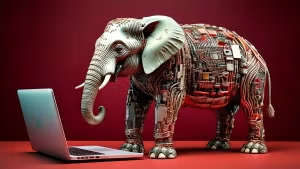
- Context: As a caption beneath an AI generated image of an elephant covered in circuitry for a UA cybersecurity news story.
- Disclaimer: Generative AI tools were used to create this image.
Do not input confidential, protected, or sensitive UA information into generative AI tools.
Generative AI tools may store or repurpose data provided as input if the appropriate data protection settings are not enabled. Never upload proprietary, confidential, student, personnel, or protected information into any AI tool without explicit approval, or certainty of the presence of data protection settings.
Examples:
- Do not upload student records, grades, or identifiable data into AI tools.
- Avoid inputting drafts of unpublished research, strategic documents, or proprietary UA data.
Do not rely exclusively on AI-generated accessibility features without human review.
While AI can assist in creating accessible content, human oversight remains necessary. Always review AI-generated alt-text, captions, and transcriptions to ensure accuracy and appropriateness for all users.
Examples:
- Manually verify AI-generated captions for accuracy before publishing videos.
- Edit AI-generated alt-text for images to accurately reflect context and relevance.
Use AI tools responsibly and ethically, in alignment with UA’s values.
AI-generated materials must reflect and support UA’s commitment to integrity and ethical conduct. Never use generative AI tools to create misleading, biased, harmful, or discriminatory content.
Do not use AI tools to generate, clone, or simulate the voice of any real person without their explicit consent.
AI-powered voice synthesis can produce realistic audio that mimics real individuals. Using such tools without clear authorization misrepresents the speaker and undermines trust in UA communications.
Examples:
- Do not use AI voice cloning tools to generate narration that sounds like a specific UA faculty member, administrator, or student.
- Do not use synthetic audio to fabricate quotes, testimonials, or statements from real individuals.
Understand that AI-generated content may not be eligible for copyright protection and may inadvertently contain copyrighted material.
The U.S. Copyright Office has indicated that content generated entirely by AI, without meaningful human creative input, may not qualify for copyright protection. Additionally, generative AI tools can reproduce elements of copyrighted works from their training data. Teams should weigh these factors when deciding where to use AI-generated material versus original human-created work, particularly for high-value or long-lived assets.
Examples:
- Be aware that AI-generated text, images, or other media used in UA materials may not be legally protectable as UA intellectual property.
- Exercise caution when using AI-generated content that closely resembles existing published works, designs, or visual styles.
- For flagship campaigns, signature creative assets, or materials with a long shelf life, prioritize original human-created work.